DFG SPP1712 Multilayer-Inserts: Ergebnispräsentation auf der Hybrid 2020

Multilayer-Inserts bieten für Mischbauweisen von Faserverbundwerkstoffen mit metallischen Werkstoffen eine optimale Verbindungstechnologie mit hervorragenden mechanischen Eigenschaften. Eine deutlich gesteigerte Leistungsfähigkeit für das Einleiten von Kräften in dünnwandige Faserverbundstrukturen konnte im Rahmen des Schwerpunktprogramms 1712 „Intrinsische Hybridverbunde“ durch den Einsatz lokaler Hybridstrukturen, die in Form von metallischen Einzellagen im Bereich der Krafteinleitung vorliegen, erzielt und nachgewiesen werden. Dabei substituieren die metallischen Einzellagen örtlich Faserlagen in gleicher Dicke. Der schichtweise Aufbau bewirkt eine Vergrößerung der Überlappungsfügung zwischen den Metalllagen und dem umgebenden Laminat und realisiert eine Einleitung der angreifenden Kraft in alle Laminatlagen mit einem in Zentrum befindlichen reinmetallischen Kern.

Auf der vom 28.4. bis zum 29.4. stattfindenden Hybrid 2020 werden die in den vergangenen sechs Jahren erzielten Ergebnisse, wie zurzeit üblich über eine Web-Konferenz, präsentiert. Wir bedanken uns herzlich bei der Deutschen Forschungsgemeinschaft (DFG) für die Förderung dieses Schwerpunktprogramms 1712 “Intrinsische Hybridverbunde” und damit unserer interdisziplinären Forschung.

Mehr zum Thema und auch zu allen weiteren Projekten auf dem YouTube Kanal des SPP1712:

Wir auf der K 2019

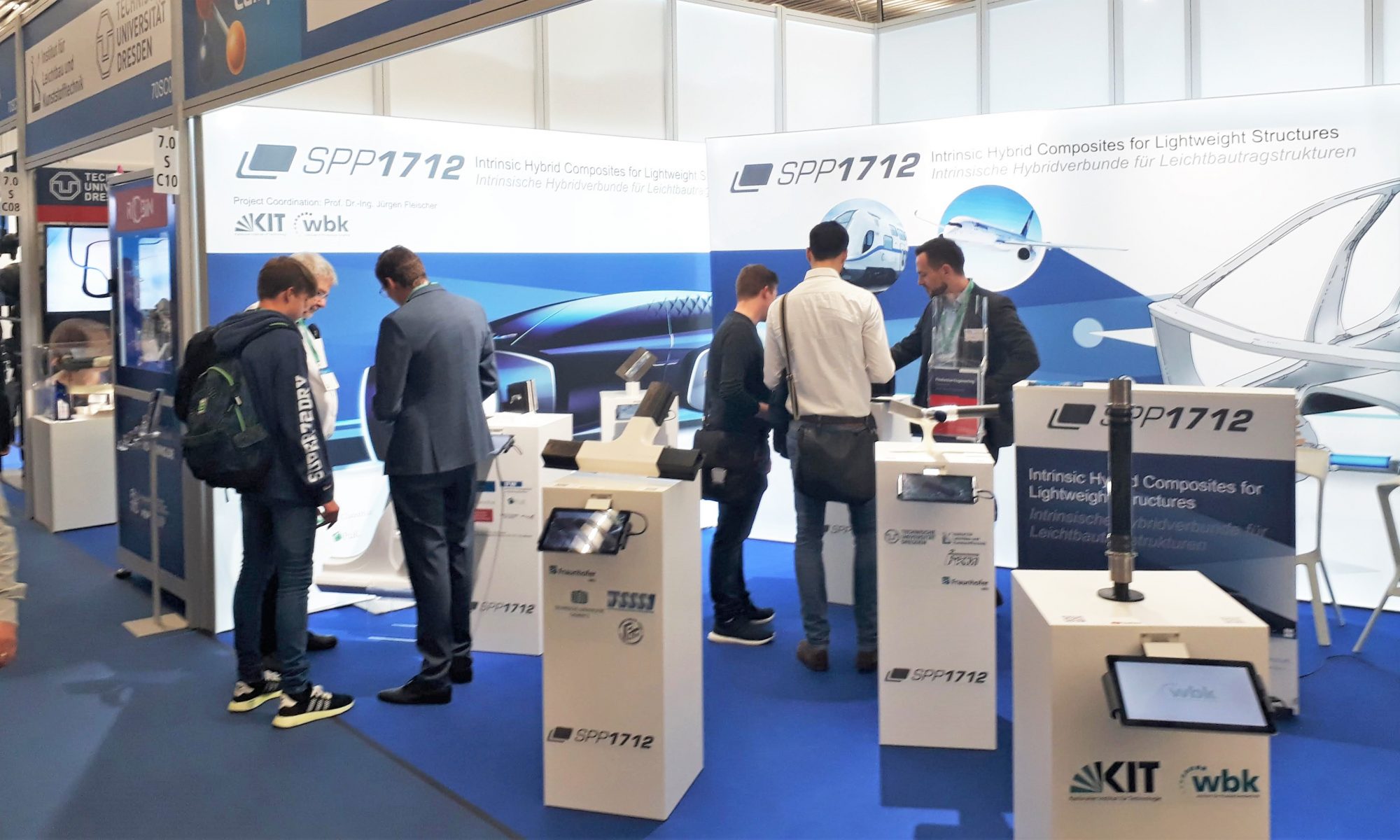
Vom 16.10. bis zum 21.10. präsentierten wir uns und unsere Ergebnisse im Bereich Faserverbund-Metall-Hybriden auf der K 2019 in Düsseldorf. Wir bedanken uns für alle konstruktiven Gespräche und neuen Kontakte, die wir auf der Messe knüpfen konnten. Wenn Sie Gelegenheit hatten, unsere Multilayer-Insert-Technologie anzuschauen oder Sie Interesse an weiterführenden Informationen haben, treten Sie gerne in Kontakt

Therm-O-Plan

Automated Path Planing and Monitoring of Automated-Fiber-Placement-Processes

The Automated-Fiber-Placement (AFP) is one of the leading manufacturing technologies in the field of cost-effective, high-quality serial production of light-weight structures. Nevertheless, both the reliability of the automated production systems and the efficiency of the process planning still offer improvement potential. In addition to the aerospace industry, the automotive industry and other high-demanding lightweight construction industries are pushing further developments.

In the AFP process, pre-impregnated carbon fibers (tows) are placed automatically on a tool surface. Due to recent technological advances in the production technology, increasingly complex components can be realized. However, this progress also leads to a higher complexity of the tools and tool surfaces. Notwithstanding available CAD/CAM-applications, the additional high structural requirements for CFRP laminates require a manual, very time consuming adaptation of the laying path while adhering to strict design rules. In addition to the selected tow paths, the process parameters have a decisive influence on the laying quality. Inadequately pre-heated tool surfaces or deviating compaction pressure can lead to defects such as tows separating from the surface. If the occurring errors are not detected and corrected, deviations from the component’s design and structural requirements occur. In general, the machine operator is responsible for assuring the quality of the product. This is usually done by visually inspecting the individual layers. This approach not only restricts the productivity of the AFP process, but also entails high repair costs for undiscovered errors which need to be corrected at a later stage. In exceptional cases this can lead to the rejection of the entire component.

The „Therm-O-Plan“ project is a cooperation between the Institute of Production Engineering and Machine Tools of the Leibniz Universität Hannover, Automation Technology GmbH and Systemtechnik Ingenieurgesellschaft mbH (SMWS). The aim of the project is to reduce the planning effort for the production of light-weight structures by automated optimized path planning. In addition, the project aims to increase the process reliability of the AFP process by means of online thermographic process monitoring. The partial developments pursued in this process are integrated in a higher-level solution approach and can easily be implemented in conventional AFP process chains.

Funding: Central Innovation Program for SMEs (ZIM)

Duration: 2015-2017

http://www.aucoteam.de/wp-content/uploads/2013/06/ZIM-Logo.jpg


Multi-Matrix-Prepreg

Online-Production of Multi-Matrix-Prepreg in Automated-Fiber-Placement

3.MMPThis project pursues the establishment of an interdisciplinary research focus “individualized CFRP light-weight structures with the aid of flexible manufacturing technologies”. Overall, this research group is based on fundamental research projects as well as application-based research project with industrial partners. The Multi-Matrix-Prepreg (MMP) project is the first step of this local strategy and addresses the area of “material-side flexibility”.

Individualized structures made of fiber reinforced plastics (FRP), in particular carbon-fiber reinforced plastics (CFRP), present a great economic and manufacturing challenge in serial production, e.g. of aircraft (hull, wing, side guide). Future competitiveness of Lower Saxony CFRP industry requires the implementation of new, flexible material, construction and manufacturing concepts. This can lead to a reduction in production costs and enable the production of further function-integrated components using CFRP to an increasing extent. Production sites that are currently producing CFRP components, such as the fuselage of the Airbus A350XWB, can be technologically strengthened for future developments. Novel Material solutions are part of the measures to further exploit the potential of CRFP. The main idea behind the project is to influence component properties by combining different matrix materials in an online impregnation process. The matrix materials can either be duroplastic, thermoplastic or an elastomer. During the online imprenation process the chosen different matrix materials can be combined at a set ratio. By using different matrix materials for one component the impact resistance, crack propagation resistance, weldability, stiffness and strenght of the finished product con be improved severely.

The objective of the collaborative project is to develop, implement and verify methods for the automated and quality-monitored production of multi-matrix laminates with continuous fibers, as well as to demonstrate the resulting application potentials. An innovative interdisciplinary approach is being developed from existing material and production concepts in order to realize MMLs with continuous fiber strands and locally selectively applied thermoplastic, elastomeric or duroplastic matrix material. In this process, the rovings are impregnated and consolidated online and in an innovative AFP tooling module. This is done in accordance to the locally used matrix material, the overall component requirements and taking into account the material-dependent process parameters.

Funding: Niedersächsisches Vorab, Volkswagen Foundation

Duration: 2016-2019

Multilayer Inserts

CFRP-Metal-Hybrid Load-Introduction-Elements for Highly Stressed Fiber Composite Structures

The aim of this research project is to develop an intrinsic hybrid interface and its manufacturing process. The interface is characterized by a load-optimized pinned structure which allows a uniform transfer of loads at the transition metallic structure into highly stressed, complex fiber-plastic composite structures. For this purpose, an intrinsically produced multilayer insert (MLI) is developed. This insert forms a novel interface for this partial structure attachment. The CFRP considered here can be used, for example, in aircraft construction or automotive engineering in the future.

In the intrinsic hybridization process several metallic layers are successively built up as part of the automated tape-laying process to form an MLI inside the simultaneously generated composite layup. This is done in an Automated Fiber Placement Process (AFP). The orientation of the individual layers, their shape and their material properties are optimized according to the requirements of the interface. The way the MLI is integrated into the layup avoids an increase in the local laminate thickness.  The illustrative example shows the idea of the new MLI (b) compared to a conventional insert (a). In the manufacturing process, the MLI is built up on a base plate on which it is centered by a stud bolt for example. With new composite layers, additional MLIs are added to the laminate and centered on the underlying layers. Their shape is based on the fiber orientation of the closest CFRP layer. In order to minimize the limitating influences of the MLI on the AFP process which are introduced for example by the centering bolt, material additives are placed in its vicinity to fill the area which cannot be reached by the laying head. They are designed in such a way that the tows can be laid-up around them (c) or attached to the stud (d) up to an additional prepreg patch.

In order to achieve the development goal, close co-operation between simulation and design, material science and production technology is carried out. The process of hybridization within the production of CFRP structures using AFP technologies is being developed. An additional development is a newly designed end effector for the process-integrated laying of metallic single layers of the MLI. In order to increase reliability during the production of complex structures, a simulation-based monitoring and control approach is developed and implemented in the system. Special materials for the individual layers of the MLI are researched and determined. They have to meet the special requirements caused by perpendicular to the laminate plane load introduction. The boundary layer behavior of the material combination in the CFRP is researched as well. For the design of the hybrid MLI component, models of material behavior are developed in the process and application. Based on those models, calculation models for the load-optimized design of individual MLI layers as well as the influence of the MLI on the bearing behavior of hybridized high-performance laminates are developed. Along with the validation of the methods and prototyping systems described here, a technology-potential-analysis for future new applications is carried out.

Funding: German Research Foundation (DFG)

Duration: 2014-2017, 2017 – 2020


FlexProCFK

Flexible Technologies for Production of individualised CFRP-Structures


This project pursues the establishment of an interdisciplinary research focus “individualized CFRP light-weight structures with the aid of flexible manufacturing technologies”. Overall, this research group is based on fundamental research projects as well as application-based research projects with industrial partners. This project is the second step of this local strategy and addresses the area of “local variant flexibility”

Within the interdisciplinary development process, the implementation of Continuous Wet Draping (CWD) and its assessment is carried out. This process requires a combination of the different core areas of expertise in the fields of structural development, new materials and autumation and production technoloy. The institutes involved in the project are recognized in their field and experienced in overcoming the additional challenges associated with an interdisciplinary collaboration.

The specific tasks to be developed or researched by the different partners are therefore derived from the expertise of the respective partner:[/vc_column_text][/vc_column][/vc_row][vc_row][vc_column][list color=”black”]

  • Development of a method for the implementation of individualization into the integrated structure and production design process (IFL)
  • Development and research of a method and a module for the targeted application of matix systems onto carbon fiber fabrics (PuK)
  • Evaluation of the novel CWD technology for flexible production of inidviualized stiffening structures in the context of the integrated design process of structure and production (IFL)
  • Reasearch and specific manipulation of the draping behavior of carbon fiber fabrics with locally variable properties on complexly curved  surfaces (PuK)
  • Development and research of a method and modules for draping variable carbon fiber fabrics on arbitrary and variable profiles (IFW)
  • Development and research of a method and its modules for the flexible stocking and on-line assembly of semi-finished CFRP products for flexible draping (IFW)

[/list][/vc_column][/vc_row][vc_row][vc_column][vc_column_text]The project „FlexProCFK“ is a cooperation between the Institute of Production Engineering and Machine Tools (IFW) of the Leibniz Universität Hannover, the Institute of Aircraft Design and Lightweight Structures (IFL) of the Technische Universität Braunschweig und the Institute of Polymer Materials and Plastics Engineering (PuK) of the Clausthal University of Technology. The aim of the project is to design and implement an innovative flexible manufacturing technology for the production of individualized CFRP structures. Within the project, Continuous Wet Draping is developed as a new production technology in carbon fiber fabrics are individually impregnated with resin and subsequently draped into complex geometries.

Funding: EUROPEAN REGIONAL DEVELOPMENT FUND (ERDF)

Duration: 2016-2019


ProDesign

Integrated method for process planning and structural design in composite structures

The project’s research hypothesis is that, with an adjusted method, it is possible to develop lightweight structures out of fiber composite material to not only reach low mass properties but also to be efficiently manufacturable. As a consequence, high engineering and production costs compared to metal designs can be reduced.

The objective is to develop and evaluate a method for the automated design of high-performance fiber composite structures and their efficient production. This comprises structural design, production planning and their interaction. The quality of a solution is determined by structural criteria (mass) as well as production criteria (production cost). Compared to conventional methods, an early consideration of production aspects prevents cost-intensive iterations in later stages of the development process. Conventional methods can only select a limited amount of solutions in the concept phase since all of them are to be fully developed in the following development steps. This method, however, is able to consider a higher number of solutions that differ in structural and production aspects. The overall development effort can be limited by gradually proceeding through the design of all solutions in parallel. In the course of this process the complexity of applied design and assessment methods is increased while the number of considered solutions is decreased. Therefore, complex methods are only used for a smaller number of solutions that qualified in preceding selections.

As an application example the development of an aircraft fuselage structure made of carbon fiber reinforced plastic (CFRP) is chosen, since it has extreme requirements that can only be met in an optimum way by using an approach with strong interaction of both disciplines.

The research is based on achievements of an interdisciplinary cooperation of the institutes in the field of high performance production of CFRP-structures practiced since 2010.

Funding: Deutsche Forschungsgemeinschaft (DFG)

Duration: 2015-2018