
Multilayer Inserts

CFRP-Metal-Hybrid Load-Introduction-Elements for Highly Stressed Fiber Composite Structures
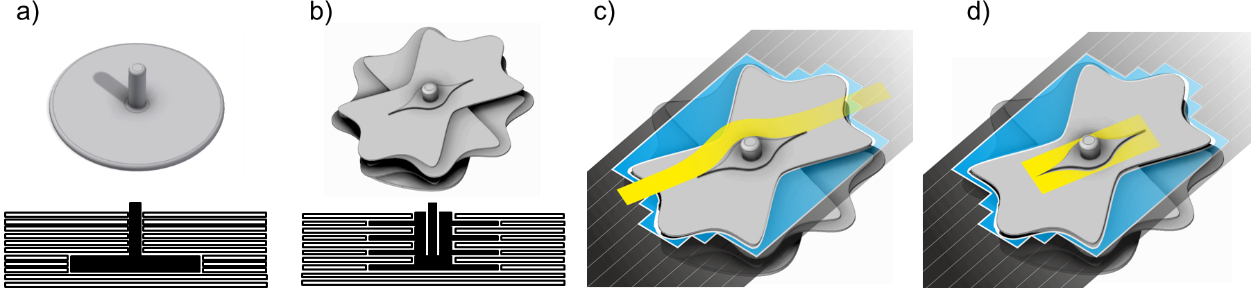
The aim of this research project is to develop an intrinsic hybrid interface and its manufacturing process. The interface is characterized by a load-optimized pinned structure which allows a uniform transfer of loads at the transition metallic structure into highly stressed, complex fiber-plastic composite structures. For this purpose, an intrinsically produced multilayer insert (MLI) is developed. This insert forms a novel interface for this partial structure attachment. The CFRP considered here can be used, for example, in aircraft construction or automotive engineering in the future.

In the intrinsic hybridization process several metallic layers are successively built up as part of the automated tape-laying process to form an MLI inside the simultaneously generated composite layup. This is done in an Automated Fiber Placement Process (AFP). The orientation of the individual layers, their shape and their material properties are optimized according to the requirements of the interface. The way the MLI is integrated into the layup avoids an increase in the local laminate thickness.  The illustrative example shows the idea of the new MLI (b) compared to a conventional insert (a). In the manufacturing process, the MLI is built up on a base plate on which it is centered by a stud bolt for example. With new composite layers, additional MLIs are added to the laminate and centered on the underlying layers. Their shape is based on the fiber orientation of the closest CFRP layer. In order to minimize the limitating influences of the MLI on the AFP process which are introduced for example by the centering bolt, material additives are placed in its vicinity to fill the area which cannot be reached by the laying head. They are designed in such a way that the tows can be laid-up around them (c) or attached to the stud (d) up to an additional prepreg patch.

In order to achieve the development goal, close co-operation between simulation and design, material science and production technology is carried out. The process of hybridization within the production of CFRP structures using AFP technologies is being developed. An additional development is a newly designed end effector for the process-integrated laying of metallic single layers of the MLI. In order to increase reliability during the production of complex structures, a simulation-based monitoring and control approach is developed and implemented in the system. Special materials for the individual layers of the MLI are researched and determined. They have to meet the special requirements caused by perpendicular to the laminate plane load introduction. The boundary layer behavior of the material combination in the CFRP is researched as well. For the design of the hybrid MLI component, models of material behavior are developed in the process and application. Based on those models, calculation models for the load-optimized design of individual MLI layers as well as the influence of the MLI on the bearing behavior of hybridized high-performance laminates are developed. Along with the validation of the methods and prototyping systems described here, a technology-potential-analysis for future new applications is carried out.

Funding: German Research Foundation (DFG)

Duration: 2014-2017, 2017 – 2020


FlexProCFK

Flexible Technologies for Production of individualised CFRP-Structures


This project pursues the establishment of an interdisciplinary research focus “individualized CFRP light-weight structures with the aid of flexible manufacturing technologies”. Overall, this research group is based on fundamental research projects as well as application-based research projects with industrial partners. This project is the second step of this local strategy and addresses the area of “local variant flexibility”

Within the interdisciplinary development process, the implementation of Continuous Wet Draping (CWD) and its assessment is carried out. This process requires a combination of the different core areas of expertise in the fields of structural development, new materials and autumation and production technoloy. The institutes involved in the project are recognized in their field and experienced in overcoming the additional challenges associated with an interdisciplinary collaboration.

The specific tasks to be developed or researched by the different partners are therefore derived from the expertise of the respective partner:[/vc_column_text][/vc_column][/vc_row][vc_row][vc_column][list color=”black”]

  • Development of a method for the implementation of individualization into the integrated structure and production design process (IFL)
  • Development and research of a method and a module for the targeted application of matix systems onto carbon fiber fabrics (PuK)
  • Evaluation of the novel CWD technology for flexible production of inidviualized stiffening structures in the context of the integrated design process of structure and production (IFL)
  • Reasearch and specific manipulation of the draping behavior of carbon fiber fabrics with locally variable properties on complexly curved  surfaces (PuK)
  • Development and research of a method and modules for draping variable carbon fiber fabrics on arbitrary and variable profiles (IFW)
  • Development and research of a method and its modules for the flexible stocking and on-line assembly of semi-finished CFRP products for flexible draping (IFW)

[/list][/vc_column][/vc_row][vc_row][vc_column][vc_column_text]The project „FlexProCFK“ is a cooperation between the Institute of Production Engineering and Machine Tools (IFW) of the Leibniz Universität Hannover, the Institute of Aircraft Design and Lightweight Structures (IFL) of the Technische Universität Braunschweig und the Institute of Polymer Materials and Plastics Engineering (PuK) of the Clausthal University of Technology. The aim of the project is to design and implement an innovative flexible manufacturing technology for the production of individualized CFRP structures. Within the project, Continuous Wet Draping is developed as a new production technology in carbon fiber fabrics are individually impregnated with resin and subsequently draped into complex geometries.

Funding: EUROPEAN REGIONAL DEVELOPMENT FUND (ERDF)

Duration: 2016-2019


ProDesign

Integrated method for process planning and structural design in composite structures

The project’s research hypothesis is that, with an adjusted method, it is possible to develop lightweight structures out of fiber composite material to not only reach low mass properties but also to be efficiently manufacturable. As a consequence, high engineering and production costs compared to metal designs can be reduced.

The objective is to develop and evaluate a method for the automated design of high-performance fiber composite structures and their efficient production. This comprises structural design, production planning and their interaction. The quality of a solution is determined by structural criteria (mass) as well as production criteria (production cost). Compared to conventional methods, an early consideration of production aspects prevents cost-intensive iterations in later stages of the development process. Conventional methods can only select a limited amount of solutions in the concept phase since all of them are to be fully developed in the following development steps. This method, however, is able to consider a higher number of solutions that differ in structural and production aspects. The overall development effort can be limited by gradually proceeding through the design of all solutions in parallel. In the course of this process the complexity of applied design and assessment methods is increased while the number of considered solutions is decreased. Therefore, complex methods are only used for a smaller number of solutions that qualified in preceding selections.

As an application example the development of an aircraft fuselage structure made of carbon fiber reinforced plastic (CFRP) is chosen, since it has extreme requirements that can only be met in an optimum way by using an approach with strong interaction of both disciplines.

The research is based on achievements of an interdisciplinary cooperation of the institutes in the field of high performance production of CFRP-structures practiced since 2010.

Funding: Deutsche Forschungsgemeinschaft (DFG)

Duration: 2015-2018


ROBUFIL

Robust Fiber-Placement Systems for Aerospace Structures

To ensure aviation’s high-capability and efficiency, the (further) development and optimization of production processes, which increase the use of light-weight structures and thus contribute to an environmentally friendly air transport system, is of crucial importance. The ROBUFIL project contributes with the development of a manufacturing facility and related technologies for the automated production of CFRP structures by combining Automated Fiber Placement (AFP) and Automated Tape Laying (ATL) in one component as well as fiber placement with different carbon fiber fabrics. The overall objective of the project is to optimize the processess of fiber placement and tape laying, with a focus on a robust fiber placement process. The Institute of Polymer Materials and Plastics Engineering is particularly working with the material and demonstator design.

At first, a base epoxy resin material is examined. Based on the results of this examination either a bonded dry-tape or a thermoplastic prepreg is examined. A deeper analysis of the starting material and of the laminate resulting form the laying-process with focus on the process parameters allows to determine a practicable model for the process and to optimize the lay-up times. The analysis espcially focuses on the interation of the temperature (heating method and rate) and thus the viscosity of the matrix and the compaction behavior of the material as well as the interaction of the carbon fiber fabric with the surfaces of the conveying system. Additionally, withing the framework of these tests, design methods for components produced in this process are to be developed and evaluated, thus supprting the efficient production of aeronautical components. The technology demonstration at the end of the project aims at transferring the  knowledge establisehd in the laboratory to the fiber-placement system by examinating the influence of the process parameters on the laminate quality directly at the plant.

The ROBUFIL project is a cooperation of the Institute of Polymer Materials and Plastics Engineering at the Clausthal University of Technology, Brötje Automation Composites GmbH and SWMS Systemtechnik Ingenieurgesellschaft mbH and is supported by the German Federal Ministry of Economic Affairs and Energy.

Funding: Federal Ministry of Economic Affairs and Energy(BMWi)

Duration: 2016-2018

csm_01_bmwi_rgb_gef_de_300_600bd75bdc

Join THIS

JoinTHIS – Production and Joining of Large Thermoplastic In-Situ Consolidated Structures

The main goal of the JoinTHIS project is to develop, implement and evaluate a manufacturing methodology based on AFP and welding technologies for thermoplastics, enabling the autoclave-free production of thermoplastic CFRP structures for the next aircraft generation. The new manufacturing method ensures an economically implementation of large-scale structural lightweight construction concepts for aircraft fuselages based on thermoplastic fiber-reinforced materials. . Due to an increasing production and resource efficiency as well as reducing CO2 emissions, the new manufacturing method is making a significant contribution to a sustainable mobility strategy as presented by the European Commission’s FlightPath 2050.

Funding: European Regional Development Fund

Duration: 2018-2021

HPCFK stellt auf dem 23. Int. Dresdner Leichtbausymposium aus

Vom 27. bis 28. Juni 2019 fand in Dresden das 23. Leichtbausymposium statt. Alexander Herwig stellte in einem Vortrag “Konzepte zur Lasteinleitung in Faserverbundstrukturen für Hochleistungsanwendungen” vor. Darüber hinaus präsentierte unsere Forschungskooperation den aktuellen Forschungsstand unseres Multilayer-Inserts auf dem Gemeinschaftsstand des SPP 1712

Weitere Impressionen zum Dresdner Leichtbausymposium finden Sie auf unserem Twitter-Account.

Neues Youtube-Video: Pneumatisch aktuiertes Festkörpergelenk in Multi-Matrix-Bauweise

Der Material-Mix des Aktuators basiert auf einem Ansatz, der in unserem kürzlich erfolgreich abgeschossenen Projekt Multi-Matrix-Prepreg verfolgt wurde: Durch die gezielte Wahl unterschiedlicher Matrixwerkstoffe (Duroplast und Elastomer) und deren Anteile lassen sich für faserverstärkte Bauteile die Eigenschaften wie Impact-Resistenz, Rissfortschrittswiderstand, Schweißbarkeit, Steifigkeiten und Festigkeiten lokal beeinflussen.

Das aktuierte Festkörpergelenk macht sich diesen Ansatz zunutze, indem es eine durchgehende duroplastische Kohlenstofffaserstruktur aufweist, die im Zentrum durch den lokalen Einsatz einer Elastomermatrix unterbrochen wird. Dadurch wirkt dieser Bereich biegeelastisch. Mit Hilfe der strukturinhärenten Aktuierung durch fluidgefüllte Druckkammern lässt sich die Struktur gezielt knicken.

Einen Eindruck des Festkörpergelenks in Aktion vermittelt unser neustes Youtube-Video. Wir danken der Volkswagenstiftung für die Förderung des Vorhabens Multi-Matrix-Prepreg.

David Christian Berg promoviert mit Auszeichnung

Am 11.02.2019 verteidigte David Christian Berg, ehemaliger Mitarbeiter unserer Forschergruppe, erfolgreich seine Dissertation mit dem Titel “An Innovative Approach for Simultaneous Measurement of Cure Shrinkage and Thermal Expansion of Reactive Liquids”. Herr Berg entwickelte im Rahmen seiner Promotion ein Messsystem, das es ermöglicht, die aushärtungsbedingte Schwindung von reaktiven Flüssigkeiten bei gleichzeitiger Messung der Wärmeausdehnung zu erfassen.

Wir gratulieren ganz herzlich zu diesem Erfolg!

Intrinsische Hybridverbunde – Arbeitskreistreffen des SPP1712 in Saarbrücken

Am 15. und 16. Januar fand auf Einladung von Prof. Fleischer und Prof. Herrmann in Saarbrücken am Fraunhofer IZFP / Lehrstuhl für Leichtbausysteme ein Treffen der Arbeitskreise Demonstrator und Produktionstechnologien sowie Bauteilnahe Beanspruchung und Gestaltungsrichtlinien des Schwerpunktprogramm 1712 statt. Aus den Arbeiten im Projekt Multilayer-Insert haben wir über eine neue Methode zur Charakterisierung von Grenzschichten in Hybridverbunden unter statischen und dynamischen Scherlasten berichtet. Dazu wird es zukünftig ein Scherwerkzeug geben, das in konventionellen Zug-/Druck-Prüfmaschinen einsetzbar ist. Erkenntnisse zum Grenzschichtverhalten unter thermomechanischer Belastung wurden diskutiert und der positive Einfluss von Epoxid-Dünnfilm-Zwischenschichten in Verbindung mit angepassten Aushärteprofilen aufgezeigt. Da in der aktuellen Förderphase des Projekts auch Krafteinleitungen in gekrümmte Oberflächen betrachtet werden, wurden erste Ergebnisse zum Anhaftungsverhalten von Metalleinlegern auf unterschiedlichen Bauteiloberflächen gezeigt. Ein Ausblick wurde in die Entwicklung eines neuen Schneidsystems für Automated Fiber Placement Systeme gegeben. Dieses wird durch einen variabel einstellbaren Schnittwinkel automatisierte Legesysteme dazu befähigen, die Konturen von CFK-Laminaten endkonturnah auszuführen, so dass nahezu keine Nachbehandlung mehr erforderlich sein wird. Für die Multilayer-Inserts bietet sich dadurch der Vorteil, dass die Einlegergeometrien deutlich näher an ein belastungs- und materialgerechteres Design angenähert werden können.